You know what it sold for. Do you know what you actually made?
Trovie is inventory and profit tracking, built for how cards actually move. Fast, in person, one card at a time. Log what you paid the second it comes in, and every sale after that already knows your margin.

They shop while you work the line
A customer scans the QR code on your table sign. They browse your inventory on their own phone. No app, no login. They build a list and hand it to you ready to check out. You still make the sale. You just stop being the one flipping through every binder to make it.
Three taps at the table
Built to work one handed, in bad convention hall lighting, with a line of people in front of you.
Scan the card art or the barcode. Trovie finds the set, the printing, and the collector number, and tells you how confident it is in the match. If it’s not sure, it says so.
Market price is already on screen. Take a percentage of it, or type your own number if you know something the market doesn’t. Add condition and quantity. Done.
Buys, sells, and trades all use the same simple entry, even a three way trade with cash added in. Every part of it still tracks back to what you actually paid.

Most inventory tools treat cost as optional. That’s how you end up with a full catalog and no idea what any of it earned you. In Trovie, you can’t add a card without a cost. Use a percentage of market price or type your own number, your choice. Either way, the number that decides your margin gets captured the moment the card comes in.
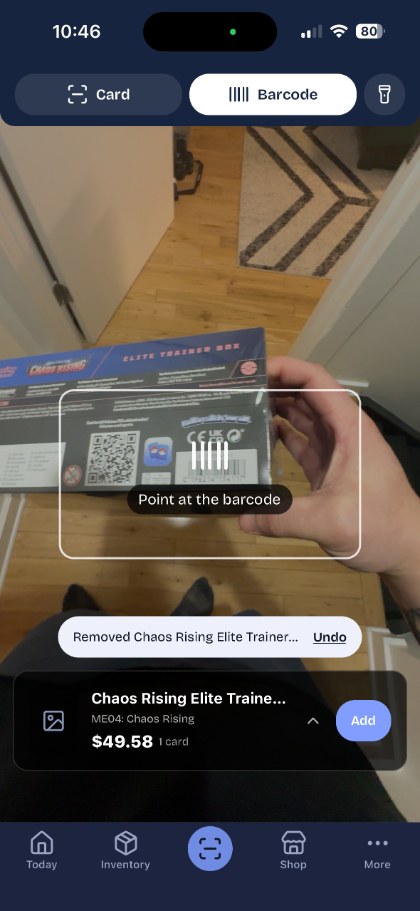
Boxes, bundles, and ETBs scan by barcode and price off the same market data as your singles. They sit in the same book, not a separate one. Most vendors we talk to track sealed product in a separate spreadsheet, if they track it at all.
“I’ve already got a system”
Most vendors we talk to do, and some of them work fine. But keeping a system running is its own job. It’s time you’re not spending buying or selling. We’re vendors too, and we built Trovie to be the back office you need, without making you run it.
Excel works when the table’s slow. The second it gets busy, you don’t have a free hand to type. Stopping to log a sale is how you lose an impatient customer. So it waits. By the time you sit down with it that night, you’ve forgotten half of what happened. Trovie logs it automatically, in the moment. There’s nothing to remember and no time spent re-entering it later.
You remember the big sales. Everyone does. What’s harder to remember is the hundreds of smaller ones, where the margins are thin and easy to lose track of. Those small sales add up to more of your business than the big hits do. Without them, you’re only seeing the highlight reel, not how you’re actually performing.
Agreed. Speed is the whole game at a show. That’s exactly why we built Trovie around the vendor’s side of the table. Quick adjustments on the fly. A transaction logged automatically the moment it happens. Take a card in, price it, and put it back out on your display in seconds. Every number behind it was tracked, not guessed.
Good instinct, and you probably built close to what you needed. But now you’re the one maintaining it. The catalog, the price feed, every new set across eight games, forever. We’ve taken on that job. And we’re not stopping at tracking. We’re building features meant to bring customers back to your table, the kind of thing that takes a real team to support. Think of us as the backend team working for you.
What’s in it
“I have no clue what my true profit margins are”
“When it comes to tracking profits, I just hope I went into the card low enough to come out on top when I do sell it”
“I’d be willing to drive up to an hour to buy the right card from an LGS”
For the people working a folding table
A show is three days of fast decisions. No backroom, no second monitor. Most software in this industry started as a desktop admin panel and got squeezed onto a phone later. We went the other way. The phone at the table is the real product. The desktop is what you open when you get home.

Clarity for the collectibles industry
We’re a group of vendors. Two of us are opening a card store together in the fall of 2026. Going in, we had a plan for tracking our margins, and it worked okay. What we didn’t have was time. Tracking every transaction properly takes someone dedicated to it at the table, sometimes more than one person, and that opens the door to mistakes. Or it takes a system built to do it automatically.
So we built one. We started with a rough version, just enough to prove the idea worked. Then we brought on a head of product to build it properly: real code, real data storage, a real product. Trovie is a company of vendors with the skills to build the software this hobby actually needs. Software that gives vendors their time back for the parts of the business that are actually fun.
There’s a second reason we care. Vendors who trust their own numbers make better calls at the table: what to pay for a card, what to let it go for. That confidence carries over to the customer on the other side of the deal. Happier customers come back, and that’s what builds real loyalty for a shop or a table. Underneath all of it, our goal is a healthier hobby, one that keeps growing for the next generation of collectors.
You can’t fix this after the fact
Once a card moves without a recorded cost, that number is gone. There’s no import and no backfill that gets it back with any real accuracy. Every week you wait is another batch of transactions you’ll never be able to account for. That gap only gets bigger the longer you put it off. The best time to start tracking is today, because today is the only day you actually can.
When you join, we’ll set you up with a personal onboarding call. We’ll walk through getting your shop set up, running your first transactions, and what’s coming next for Trovie. We built this to be simple enough to figure out on your own. But we’d rather make sure you’re getting everything out of it from day one. Tell us where you sell, and we’ll be in touch to schedule your spot.

